Embryo Monitoring and Cultivation
Precision Science at Gynatal Timișoara
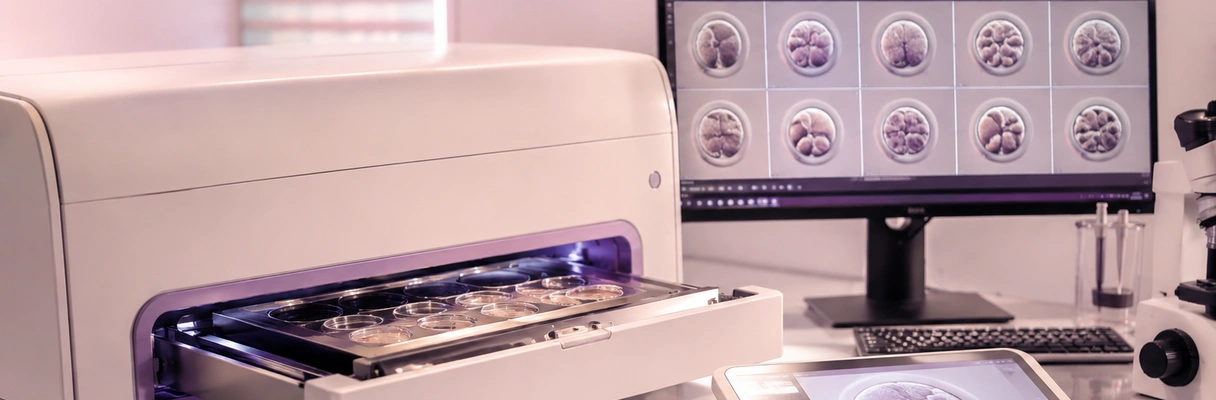
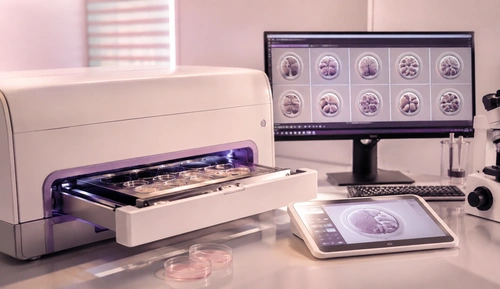

Embryo monitoring and cultivation at Gynatal Clinic (Timișoara) utilize Time-Lapse technology (EmbryoScope) and AI algorithms (iDAScore) to ensure a completely undisturbed development environment. By extending cultivation to the blastocyst stage (Day 5-6), our team, led by Lect. Univ. Dr. Delia Huțanu, achieves superior selection accuracy and higher implantation rates, significantly reducing the time to pregnancy for complex IVF cases.
Extended Cultivation: The Blastocyst Standard
At Gynatal, extended cultivation—growing embryos until Day 5 or 6—is our "Scientific Gold Standard". This process mimics the natural biological timeline where an embryo typically reaches the uterus and begins implantation.
Natural Selection in the Laboratory
Many embryos stop developing between Day 3 and Day 5 due to internal chromosomal abnormalities. By cultivating embryos to the blastocyst stage, we allow for a natural triaging process, ensuring that only those with the highest developmental and implantation potential are selected for transfer. This approach also enables Single Embryo Transfer (SET), which reduces the medical risks associated with multiple pregnancies.
Undisturbed Development via Time-Lapse (EmbryoScope)
Traditional monitoring requires removing embryos from the incubator daily for microscopic assessment, which exposes them to minor fluctuations in temperature, pH, and light.
Gynatal utilizes Time-Lapse technology to eliminate these environmental stressors:
-
Constant Environment: Embryos remain in a strictly controlled environment (37°C, optimized O2/CO2) throughout their development.
-
Continuous Imaging: Automated microscopic cameras capture images every 5–15 minutes, creating a detailed video of the embryo's growth.
-
Superior Diagnostics: This continuous data allows embryologists to see subtle division anomalies—such as direct cleavage (splitting into three cells instead of two)—that would be missed during a once-daily manual check.
AI-Assisted Selection: iDAScore
To further enhance selection precision, we integrate Artificial Intelligence (AI) into our monitoring workflow.
-
Objective Scoring: Algorithms trained on millions of global embryo outcomes analyze morphokinetic parameters to generate a viability score, known as iDAScore.
-
Standardization: AI removes the subjectivity inherent in manual morphological assessment, providing a uniform, data-backed evaluation.
-
Predictive Power: The system estimates the probability of successful implantation and live birth, assisting the embryology team in prioritizing the best embryo for the first transfer.

Transparency and Patient Engagement
Aligned with Information Foraging Theory, we empower patients through transparency during the laboratory phase.
- Personalized Embryo Reports: Patients can receive reports including embryo photographs and development summaries.
- Anxiety Reduction: By transforming the laboratory from a "black box" into a transparent process, we provide patients with a clearer understanding of their treatment's progress.